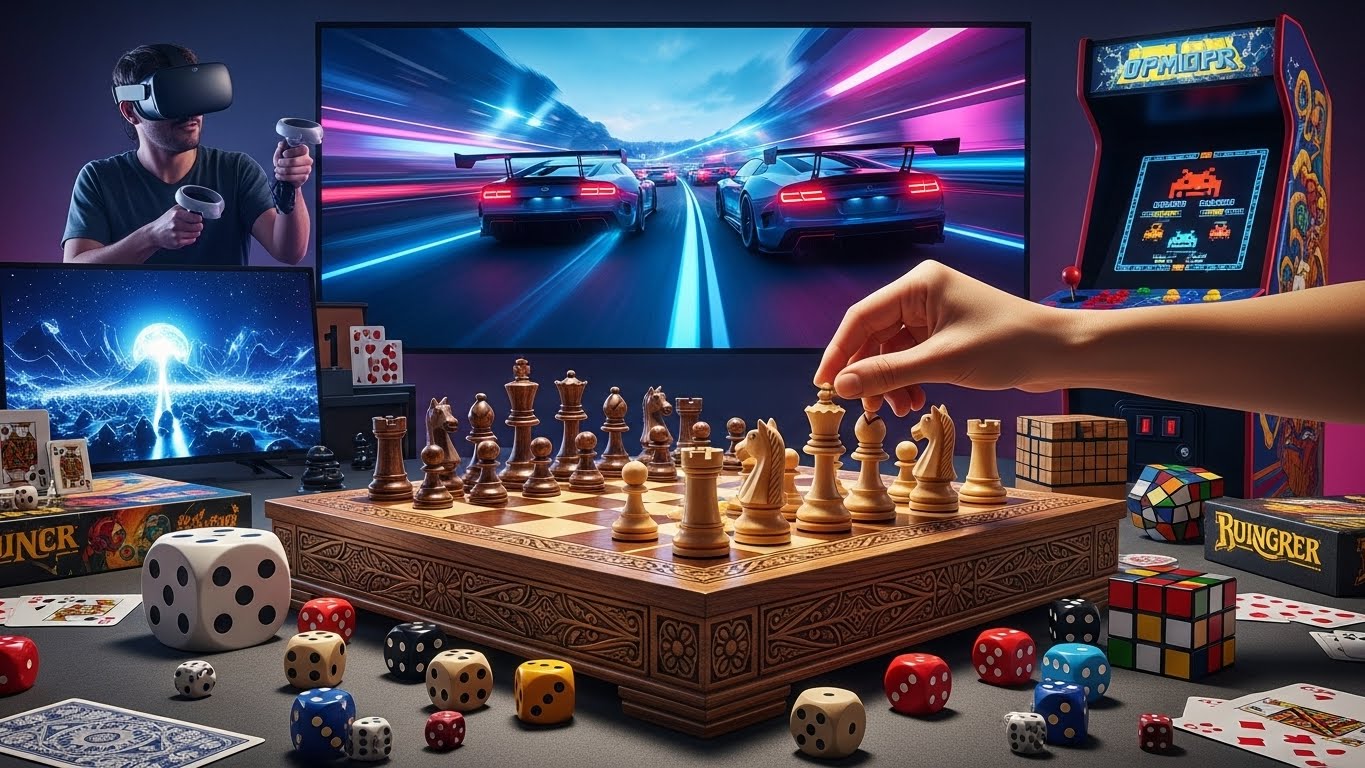
Games have been an essential part of human culture for centuries, evolving from simple board games and physical sports to complex digital experiences that reach millions worldwide. They entertain, challenge, and even educate, creating immersive worlds that captivate players of all ages. From traditional tabletop games to modern video games, the gaming industry has grown into a multi-billion-dollar sector that influences technology, media, and social interactions. This blog explores the evolution of games, the diversity of gaming genres, technological innovations, social and educational impacts, and the future of interactive entertainment.
The Evolution of Games
The history of games stretches back thousands of years. Ancient civilizations developed board games such as Senet in Egypt and Go in China, designed not only for amusement but also for strategic thinking and social bonding. Card games and dice games emerged in various cultures, creating communal experiences that combined luck, skill, and competition.
With the industrial revolution and advances in technology, physical sports and organized competitions became more prevalent. Chess, checkers, and other classic games gained formalized rules, professional tournaments, and global recognition. These early forms of gaming laid the foundation for modern entertainment, emphasizing strategy, social interaction, and skill development.
The late 20th century marked a revolutionary shift with the introduction of digital games. Early arcade machines and home consoles brought interactive entertainment into homes, allowing players to experience worlds beyond their imagination. Video games such as Pac-Man, Super Mario Bros., and Tetris became cultural phenomena, creating communities and fandoms around shared experiences.
The Diversity of Gaming Genres
The gaming world is vast, with genres that cater to different preferences and play styles. Understanding these genres helps explain why games appeal to such a broad audience.
Action and Adventure Games
Action games test reflexes, speed, and precision, often featuring combat, platforming, or exploration challenges. Adventure games combine storytelling with puzzles and exploration, immersing players in captivating narratives. Popular titles in this genre allow players to experience epic quests, uncover secrets, and engage with richly detailed worlds.
Role-Playing Games
Role-playing games (RPGs) emphasize character development, decision-making, and narrative depth. Players assume the roles of characters in a fictional world, making choices that influence the story’s progression. RPGs can be single-player experiences or online multiplayer adventures, offering long-term engagement through quests, leveling systems, and skill customization.
Simulation and Strategy Games
Simulation games recreate real-world activities or scenarios, ranging from city-building to life management. Players are tasked with problem-solving and resource management, creating immersive experiences that mimic reality. Strategy games focus on planning, tactics, and decision-making, challenging players to outthink opponents in competitive or cooperative environments.
Sports and Racing Games
Sports and racing games replicate real-life athletic competitions, appealing to fans of physical sports and competitive gameplay. These games can simulate realistic sports mechanics, team management, and racing physics, providing players with an authentic experience while allowing them to test their skills virtually.
Casual and Mobile Games
Casual games are designed for easy access and short play sessions, often focusing on simple mechanics, puzzles, or social interactions. Mobile gaming has popularized casual games, making entertainment portable and accessible to a broad audience. From puzzle challenges to interactive story games, casual gaming attracts players seeking fun without intense commitment.
Multiplayer and Online Games
Online multiplayer games allow players to interact with others in real time, fostering community, collaboration, and competition. Massively multiplayer online role-playing games (MMORPGs) and battle royale games create expansive virtual worlds where thousands of players coexist and compete. Social features, guilds, and in-game events enhance the communal experience, turning games into social platforms.
Technological Innovations in Gaming
Technology has transformed the gaming industry, enabling more immersive, interactive, and visually stunning experiences.
Graphics and Visual Effects
Advancements in graphics and visual effects have revolutionized how players experience games. High-definition textures, realistic lighting, and detailed character models create environments that rival cinematic productions. Photorealistic graphics enhance immersion, allowing players to feel fully engaged in virtual worlds.
Artificial Intelligence
Artificial intelligence is widely used in modern games to control non-player characters, generate dynamic environments, and adapt gameplay based on player behavior. AI enables more realistic interactions, smarter opponents, and tailored challenges, making gaming experiences more engaging and unpredictable.
Virtual and Augmented Reality
Virtual reality (VR) and augmented reality (AR) have taken gaming to new levels of immersion. VR headsets allow players to step into fully interactive 3D worlds, engaging all senses for a highly realistic experience. AR overlays digital elements onto the real world, blending physical and virtual environments for interactive gameplay that expands the possibilities of traditional gaming.
Cloud Gaming and Streaming
Cloud gaming allows players to access high-quality games without owning powerful hardware. Games are streamed from remote servers, enabling instant access across devices. This technology democratizes gaming, making high-end experiences available to players with limited technical resources.
The Social Impact of Games
Games are more than just entertainment; they shape social interactions and cultural trends. Multiplayer games, online communities, and social features foster collaboration, teamwork, and competition. Players form friendships, participate in virtual events, and engage in global communities centered around shared interests.
Gaming also provides a platform for cultural storytelling. Games often incorporate themes, narratives, and settings from diverse cultures, exposing players to new perspectives. This cultural exchange can promote understanding, creativity, and global awareness.
Educational and Cognitive Benefits
Games are increasingly recognized for their educational potential. Many games improve problem-solving, critical thinking, and strategic planning. Puzzle games, simulations, and strategy games challenge players to analyze situations, make decisions, and adapt to evolving scenarios.
Educational games and gamified learning platforms use interactive mechanics to teach subjects such as mathematics, history, and languages. By incorporating rewards, challenges, and interactive storytelling, these games make learning engaging and effective. Even traditional games can develop cognitive skills such as memory, attention, and spatial awareness.
Economic Significance of Gaming
The gaming industry is a major contributor to the global economy. It creates employment across software development, design, marketing, esports, and content creation. Gaming companies invest heavily in research and development, driving technological innovation that often extends beyond entertainment into fields such as AI, VR, and simulation technology.
Esports has emerged as a professional avenue within gaming, generating revenue through sponsorships, tournaments, and streaming platforms. Professional players, content creators, and gaming influencers contribute to a thriving ecosystem, making gaming both a career and a cultural phenomenon.
Challenges in the Gaming Industry
Despite its growth, the gaming industry faces challenges. Addiction and excessive screen time are growing concerns, especially among younger players. Developers and communities are increasingly promoting responsible gaming habits, such as breaks, parental controls, and balanced playtime.
Cybersecurity is another critical issue. Online multiplayer games and gaming platforms often involve financial transactions and personal data. Protecting players from fraud, hacking, and privacy breaches is a constant challenge requiring advanced security measures.
Market competition is intense, with thousands of new games released annually. Standing out requires innovation, high-quality design, and strong marketing strategies. Developers must balance creativity with commercial viability, ensuring games are both engaging and financially sustainable.
Future Trends in Gaming
The future of gaming promises continued innovation and expansion. Mobile and casual gaming will remain dominant, reaching broader audiences who seek accessible entertainment. Cloud gaming and streaming services will further democratize access to high-quality experiences.
Virtual reality, augmented reality, and mixed reality will continue to create immersive worlds, bridging the gap between physical and digital play. Artificial intelligence will enhance game design, adaptive storytelling, and personalization, creating experiences tailored to individual players.
Esports and competitive gaming will grow, offering new career opportunities and entertainment avenues. Games will increasingly serve as platforms for social interaction, education, and cultural expression, extending their influence beyond mere recreation.
Conclusion
Games are an integral part of modern culture, providing entertainment, education, and social interaction. From ancient board games to cutting-edge digital experiences, gaming has continually evolved to meet the needs of players. Technological innovations, diverse genres, and immersive experiences have transformed games into powerful tools for engagement and creativity.
The gaming industry is more than a source of fun; it shapes social behavior, cognitive development, and even economic growth. As virtual reality, artificial intelligence, and cloud gaming continue to advance, the possibilities for interactive entertainment are virtually limitless. Games are not just a pastime—they are a reflection of human creativity, collaboration, and the desire to explore new worlds.
The future of gaming promises experiences that are more immersive, socially connected, and culturally impactful than ever before, solidifying its role as a cornerstone of modern entertainment.