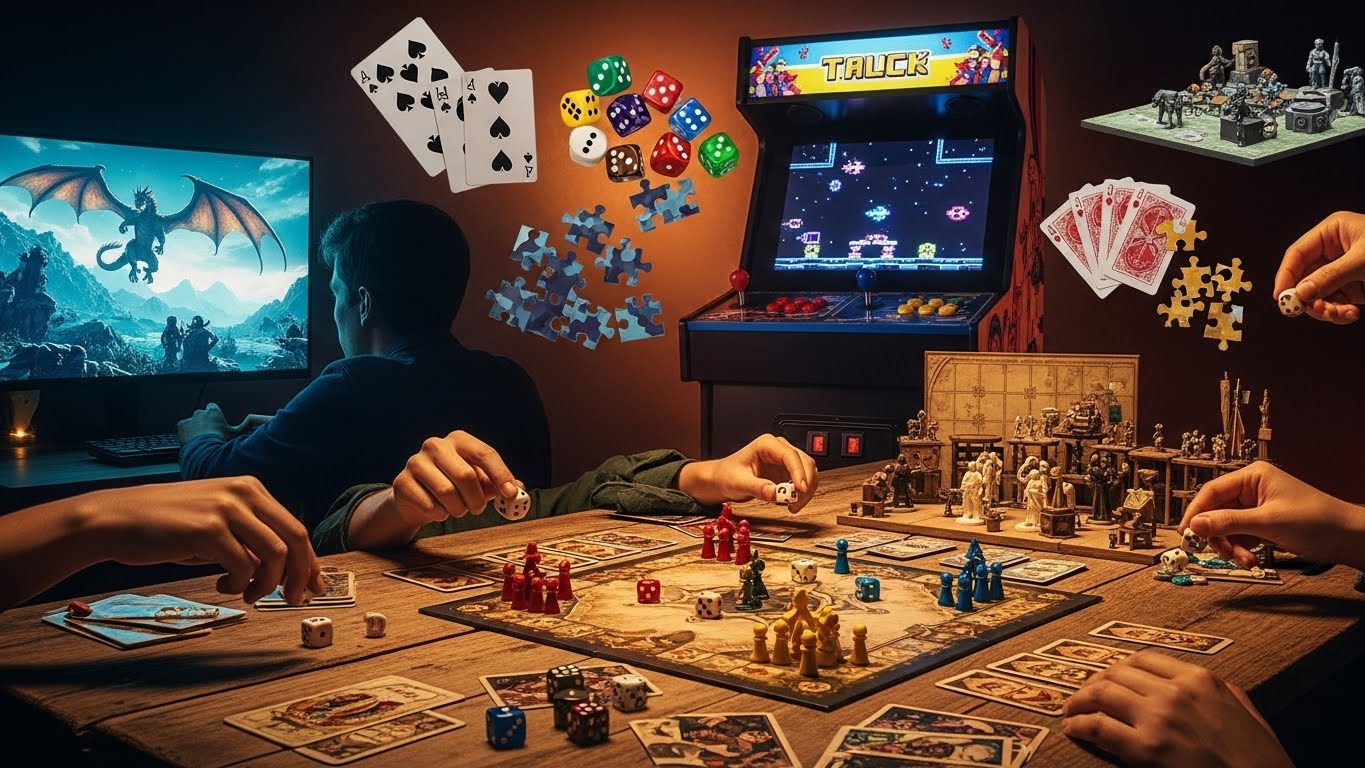
The world of gaming has seen an astonishing transformation over the years, evolving from simple pastimes to expansive digital ecosystems that engage millions of players worldwide. Whether it’s the excitement of competitive esports, the immersive experience of role-playing games, or the relaxation offered by puzzle games, games have become an essential part of our daily lives. With technology driving innovation and changing how we experience games, the question arises—what is it about games that make them so universally appealing, and how have they evolved to fit the modern world?
In this post, we’ll explore the different types of games, their historical roots, the impact of technology on gaming, and the future of this global phenomenon.
The Beginning of Gaming: A Journey Through Time
Games have been part of human culture for centuries. Early games were simple, social activities that brought people together. Board games like Chess, Go, and backgammon have existed for thousands of years, with roots in ancient civilizations such as Egypt, China, and Greece. These early games were more than just entertainment; they were often used for intellectual stimulation, teaching strategy, and promoting social interaction.
The digital age marked the beginning of a new era in gaming. The 1950s and 1960s saw the emergence of the first computer-based games, such as Tennis for Two and Spacewar!, which laid the groundwork for future technological advancements. The release of Pong in the early 1970s by Atari marked the official birth of video gaming, setting off a chain reaction of innovations that led to the video game industry we know today.
As gaming continued to evolve, the advent of home consoles, PCs, and handheld devices opened up new possibilities, allowing players to engage with digital worlds in increasingly interactive ways. Today, games come in a variety of forms, catering to a wide spectrum of players and offering experiences that range from competitive multiplayer tournaments to deeply emotional single-player narratives.
Types of Games: A Universe of Possibilities
One of the most exciting aspects of gaming is the sheer variety of genres available. Each type of game offers something unique, appealing to different tastes, skill levels, and preferences. Let’s take a look at some of the most popular genres in the gaming world today.
1. Action and Adventure Games
Action and adventure games have been staples of the gaming industry since its inception. These games often combine elements of exploration, combat, and puzzle-solving, offering immersive experiences that keep players on the edge of their seats. Some of the most iconic franchises in this category include The Legend of Zelda, Grand Theft Auto, and Uncharted.
What makes action and adventure games so compelling is their ability to offer vast, open worlds where players can explore, interact with characters, and engage in various activities. Games like The Witcher 3 or Red Dead Redemption 2 provide not only thrilling combat but also deeply woven narratives and lifelike environments, making players feel as if they are part of a living, breathing world.
2. Role-Playing Games (RPGs)
Role-playing games have a long-standing tradition in both tabletop and video gaming. These games allow players to take on the role of a character and make choices that influence the storyline. RPGs can range from fantasy epics to futuristic space adventures. Popular examples include Final Fantasy, The Elder Scrolls, and Mass Effect.
RPGs are particularly known for their focus on character progression. Players can level up their characters, acquire new abilities, and make important decisions that shape the game world. This level of customization and narrative depth provides a sense of agency that draws players into the game world, often making them feel as though they are living the story rather than merely observing it.
3. Strategy Games
Strategy games, whether real-time or turn-based, challenge players to think critically and plan ahead. These games often involve resource management, tactical decision-making, and large-scale battles. Popular strategy games like StarCraft, Civilization, and XCOM have dedicated fanbases due to their complex mechanics and rewarding depth.
What distinguishes strategy games is their reliance on brainpower rather than reflexes. Players must carefully consider every move, anticipate the enemy’s strategy, and adapt their tactics to achieve success. Whether it’s commanding an army in a war simulation or managing a civilization’s growth, strategy games require patience, foresight, and tactical mastery.
4. Sports and Racing Games
Sports and racing games offer players the chance to engage in realistic, competitive action without leaving the comfort of their homes. Whether it’s the fast-paced action of FIFA, the high-speed thrills of Gran Turismo, or the strategic management of Football Manager, these games cater to both fans of specific sports and those who just enjoy the thrill of competition.
Sports games often replicate real-world sports to an astonishing degree of realism, thanks to advanced physics engines, lifelike graphics, and detailed player movements. Racing games, on the other hand, focus on adrenaline-pumping speed and precision, allowing players to compete on a variety of tracks, whether they are racing cars, motorcycles, or even futuristic vehicles.
5. Puzzle and Casual Games
Not all games are about intense action or complex narratives—some focus on simple, relaxing gameplay. Puzzle games like Tetris, Candy Crush, and Bejeweled have long been popular among casual gamers who want a quick, satisfying experience. These games often feature easy-to-understand mechanics, but can still offer challenging puzzles that require logic and strategy to solve.
Casual games often have mass appeal because they don’t require a huge time commitment or advanced skills. They are perfect for players looking for an engaging distraction during their lunch break or while waiting for a bus. Despite their simplicity, casual games can be highly addictive, and many have built a strong following due to their accessibility and charm.
The Impact of Technology on Games
As technology has advanced, so too has the gaming experience. The evolution of hardware and software has continually pushed the boundaries of what games can achieve, leading to more immersive, visually stunning, and complex experiences.
1. Graphics and Visuals
One of the most noticeable advancements in gaming has been the improvement of graphics. From the pixelated visuals of early arcade games to the lifelike environments of modern blockbusters, the evolution of game graphics has been nothing short of extraordinary. Technologies like ray tracing, 4K resolution, and photorealistic textures have allowed developers to create worlds that feel incredibly real, even though they are entirely virtual.
The increasing power of gaming consoles and PCs, combined with the use of cutting-edge graphic design techniques, has led to an explosion in visually captivating games. Titles like Cyberpunk 2077, The Last of Us Part II, and Horizon Zero Dawn showcase the incredible potential of modern game engines to create expansive, detailed worlds that captivate players from start to finish.
2. Virtual Reality (VR) and Augmented Reality (AR)
Virtual reality and augmented reality have opened up exciting new frontiers for gaming. VR headsets like the Oculus Rift and PlayStation VR allow players to fully immerse themselves in a game world, experiencing it as if they are physically present within it. This creates a level of immersion that traditional gaming formats simply cannot match.
AR games, on the other hand, blend the virtual and real worlds together. Pokémon GO is one of the most successful examples of AR gaming, as players are able to find and catch virtual Pokémon in the real world using their smartphone’s camera and GPS. The ability to interact with both the physical and digital worlds in real-time opens up new creative possibilities for game developers.
3. Cloud Gaming and Cross-Platform Play
Cloud gaming has become a game-changer for players who may not have access to high-end hardware. Services like Google Stadia and NVIDIA GeForce NOW allow players to stream games directly to their devices without the need for powerful gaming consoles or PCs. This not only makes gaming more accessible but also eliminates the need for large downloads and installations.
Cross-platform play is another technological advancement that has become increasingly popular. It allows players on different gaming systems, such as PlayStation, Xbox, and PC, to play together in the same game. This has helped to foster larger, more diverse online communities, ensuring that no matter which platform you own, you can still connect with friends and fellow players.
The Future of Games: What Lies Ahead?
As gaming technology continues to evolve, the future holds exciting possibilities. Artificial intelligence, for instance, has the potential to create more dynamic and responsive non-playable characters (NPCs) that adapt to the player’s actions in real time, offering more personalized and unpredictable gaming experiences.
Additionally, the rise of esports and online gaming has opened up new avenues for competitive play, with professional leagues and tournaments now attracting millions of viewers worldwide. Esports will likely continue to grow, offering new opportunities for players and content creators to make careers in the gaming industry.
With the continued evolution of VR and AR, we may also see more immersive and physically interactive games, where players are not just controlling characters through controllers but are physically moving in the game world. Haptic feedback, motion capture, and even full-body suits could revolutionize how we experience virtual environments.
Conclusion: Games as a Universal Language
Games have come a long way since the first rudimentary digital experiments of the 1950s. Today, they are a global phenomenon that appeals to millions of people across all ages and backgrounds. Whether you’re a casual gamer looking for a quick escape, a competitive player striving for victory, or someone who enjoys getting lost in a rich narrative, games offer something for everyone.
As technology continues to evolve, games will undoubtedly continue to change, but one thing will always remain the same—the universal appeal of play. The world of games is vast, diverse, and ever-growing, and its future promises even more innovation, excitement