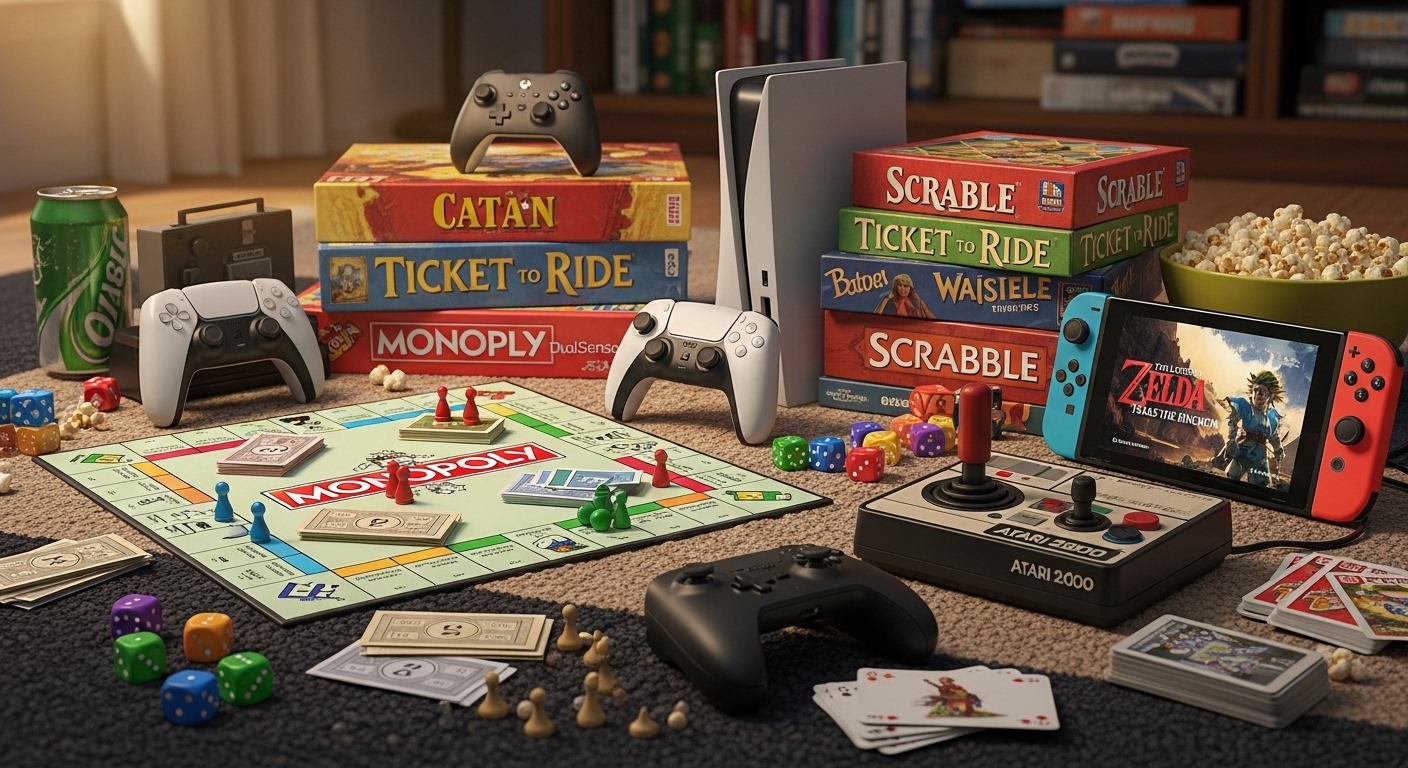
Games have been an intrinsic part of human culture for centuries, evolving from simple pastimes to a massive industry that entertains billions of people across the globe. The concept of gaming—whether through physical, mental, or digital means—has always been a way for individuals to engage, learn, socialize, and challenge themselves. What started with rudimentary board games, sports, and outdoor activities has now evolved into the multi-billion-dollar digital gaming industry that encompasses video games, mobile apps, online gaming, and even virtual reality.
This blog post will take a journey through the fascinating world of games, exploring the origins, the evolution, and the impact of gaming on modern society. We’ll also look at where the gaming industry is headed, as technological advancements continue to shape the way we play and experience games.
The Origins of Games: Simple Pleasures to Structured Play
The history of games dates back thousands of years, with evidence of early games found in ancient civilizations across the world. The earliest known board game, Senet, was discovered in Egypt and dates back to around 3100 BCE. It is believed that games like Senet served both as entertainment and as a form of ritualistic activity. The ancient Mesopotamians and the Chinese also developed early forms of games that incorporated elements of strategy, skill, and chance.
These early games were simple in nature, often based on luck or the ability to move pieces across a board. They served as a way to bring people together, promote social interaction, and sometimes even offer insights into spiritual or philosophical matters. As civilizations advanced, games also began to evolve in complexity.
One of the most iconic games from antiquity is chess, which originated in India around the 6th century CE. The game’s intricate strategy and depth made it not only a popular pastime but also a tool for intellectual development. Go, a strategy board game originating in China, has similarly remained a highly regarded game due to its simple rules and immense complexity.
While these early games were confined to physical spaces, they laid the foundation for the much larger and more diverse world of gaming that would emerge centuries later.
The Rise of Modern Games: From Board Games to Video Games
By the 19th century, games had become more structured, with well-defined rules and formats. The Industrial Revolution had an enormous impact on the development of games, as new printing technologies made board games more accessible to the masses. Games like Monopoly (created in 1933) and Scrabble (introduced in 1938) became household staples, allowing families to gather around the table and engage in friendly competition.
However, the real shift in the gaming world occurred in the 20th century with the invention of video games. In the 1950s and 1960s, early experiments in electronic entertainment began to take shape. One of the first notable examples was Tennis for Two, created in 1958 by physicist William Higinbotham. While rudimentary by today’s standards, it provided a glimpse into the potential for interactive, computer-based entertainment.
The 1970s marked the true birth of the video game industry, with the release of arcade games like Pong, developed by Atari in 1972. Pong was a simple table tennis simulation, but its impact on the gaming world was profound. It sparked the rise of arcades, where people could gather to play games, and laid the groundwork for the creation of home gaming consoles.
In 1980, Pac-Man was released, followed by other iconic games like Space Invaders, Donkey Kong, and Asteroids. These games were not just technological marvels—they were cultural phenomena. They brought gaming to a wider audience, introduced colorful graphics and sound, and set the stage for future innovations in the industry.
The Golden Age of Console Gaming: From NES to PlayStation
In the 1980s and 1990s, the video game industry exploded with the introduction of home consoles. The Nintendo Entertainment System (NES) revolutionized gaming by making high-quality video games accessible in the comfort of people’s homes. With titles like Super Mario Bros., The Legend of Zelda, and Metroid, the NES became the most successful gaming system of its time, cementing Nintendo as a leading force in the industry.
Following the success of the NES, Sega introduced the Sega Genesis (Mega Drive) in 1988, which brought classic titles such as Sonic the Hedgehog and Streets of Rage to the forefront. The rivalry between Nintendo and Sega became one of the most well-known and intense competitive battles in the history of gaming, pushing both companies to innovate and improve their hardware and software.
The 1990s also saw the advent of 3D graphics in games, with consoles like the Sony PlayStation and the Nintendo 64 taking gaming to a whole new level. Super Mario 64, released in 1996, was one of the first true 3D platformers, and its success helped define a new generation of games. Sony’s PlayStation (released in 1994) introduced classics such as Final Fantasy VII, Gran Turismo, and Metal Gear Solid, marking the beginning of a shift toward more complex, cinematic gaming experiences.
This period is often referred to as the “Golden Age of Console Gaming,” a time when the industry matured and gaming became an established form of mainstream entertainment. As consoles became more powerful, developers were able to create increasingly complex and immersive worlds that captured the imaginations of players worldwide.
The Rise of Online and Mobile Gaming
While the late 20th century was a period of immense growth for console gaming, the early 2000s marked the rise of online gaming and mobile gaming, both of which would change the landscape of the industry forever.
Online gaming, which had existed in some form since the early days of the internet, gained massive popularity with the advent of high-speed internet connections. World of Warcraft, released in 2004, became one of the most successful online role-playing games (RPGs) in history, offering a vast, persistent world where millions of players could interact, form alliances, and compete in real-time.
At the same time, mobile gaming took off, thanks to the proliferation of smartphones. The release of the iPhone in 2007 marked the beginning of a mobile gaming revolution, with games like Angry Birds and Candy Crush Saga becoming global phenomena. Mobile games were accessible to anyone with a smartphone, and their ease of use, casual gameplay, and free-to-play models made them incredibly popular.
The rise of mobile and online gaming also saw the advent of new genres, including battle royale games, multiplayer online battle arena (MOBA) games, and esports. Titles like Fortnite, League of Legends, and PUBG became cultural touchstones, with millions of players competing and spectating online. Esports, once a niche hobby, grew into a multi-billion-dollar industry, with professional players and teams, global tournaments, and massive viewership numbers.
The Impact of Technology: Virtual Reality and the Future of Gaming
The gaming industry continues to evolve at an astonishing rate, and technology plays a crucial role in shaping the future of play. Virtual reality (VR) and augmented reality (AR) are two of the most exciting advancements in gaming, offering more immersive and interactive experiences than ever before.
VR gaming, which allows players to enter fully realized 3D worlds using a headset and motion controllers, is slowly gaining traction. Titles like Half-Life: Alyx and Beat Saber have demonstrated the potential of VR, offering players a sense of presence and immersion that is unparalleled in traditional gaming. As VR hardware becomes more affordable and accessible, it’s likely that VR will become a significant part of the gaming landscape in the coming years.
AR gaming, on the other hand, overlays digital elements onto the real world, allowing players to interact with virtual objects in their physical environment. Pokémon GO, which became a global sensation in 2016, was one of the first successful AR games, and it demonstrated the potential of blending the real and virtual worlds. As AR technology continues to improve, we can expect to see more innovative gaming experiences that blur the line between reality and digital environments.
The future of gaming also lies in cloud gaming and artificial intelligence (AI). Cloud gaming services like Google Stadia, Xbox Cloud Gaming, and Nvidia GeForce Now allow players to stream games directly from the cloud without needing powerful hardware. This could revolutionize the industry by making high-quality gaming accessible to a broader audience.
AI, meanwhile, is being used to create smarter, more reactive game worlds. Games are becoming more dynamic and adaptive, with AI-powered NPCs (non-playable characters) that can learn from player behavior, offering more realistic and personalized experiences.
The Cultural Impact of Games: Connecting People Across the Globe
Games have always been a form of entertainment, but in the 21st century, they’ve evolved into a powerful cultural force. Gaming communities have sprung up around almost every major title, creating spaces for players to connect, share experiences, and build friendships across the globe.
In addition to entertainment, gaming has become a form of self-expression, with players using games to tell stories, create art, and share their creativity with others. Platforms like Twitch and YouTube have turned gaming into a spectator sport, with millions tuning in to watch professional players, streamers, and content creators showcase their skills and personalities.
Gaming has also made significant strides in breaking down cultural and social barriers. Online multiplayer games allow players from different countries, cultures, and backgrounds to come together and collaborate, fostering a sense of global community.